
A-Khata vs B-Khata in Bengaluru: What Apartment Buyers Should Understand Before Booking
Introduction
When buying a property in Bengaluru, homebuyers often hear terms such as A-Khata, B-Khata and e-Khata.
These terms can be confusing, especially for first-time buyers trying to understand whether a property has the necessary records and approvals.
A Khata is an important municipal property record, but it should not be treated as proof of ownership or as a substitute for all property approvals.
Before booking an apartment or purchasing a site, it is important to understand what the Khata record tells you—and what it does not.
1. What is a Khata?
A Khata is a property account maintained by the relevant municipal or local authority.
It generally records property details for municipal administration and property-tax purposes, including the person primarily responsible for paying property tax.
It is an important document for property-related civic and tax processes.
However, a Khata certificate by itself does not establish clear legal ownership or prove that every construction and land-use approval is in place.
2. What is A-Khata?
A-Khata refers to a property entered in the A-Khata register maintained by the relevant local authority.
It generally indicates that the property has been recorded in the applicable municipal assessment system under the A-Khata category.
However, homebuyers should not assume that the presence of an A-Khata document alone proves that the title is clear or that every building approval is valid.
The underlying title documents, sanctioned plan, land-use permissions and other applicable approvals must still be checked.
3. What is B-Khata?
B-Khata refers to a property recorded in the B-Khata register.
Such records may relate to properties with certain outstanding planning, approval or documentation issues, depending on the property's history and applicable rules.
A B-Khata entry should prompt buyers to investigate the underlying property records carefully.
It does not, by itself, establish that a property can be regularised or converted to A-Khata.
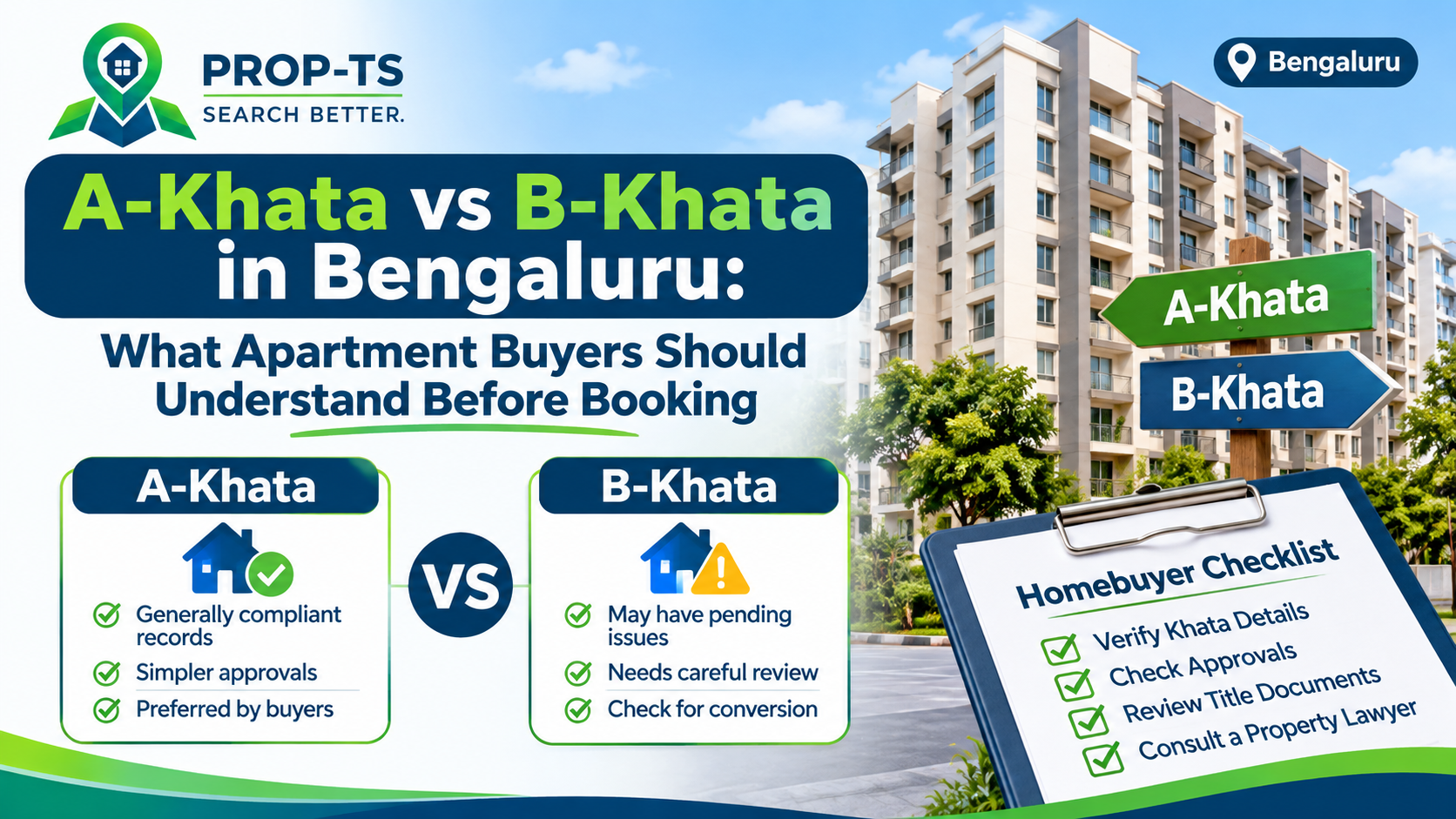
4. A-Khata vs B-Khata: Key Differences
A-Khata
- The property is recorded in the A-Khata register.
- It is generally associated with the applicable municipal assessment category.
- Buyers must still independently verify the property's title documents, building approvals and other legal records.
- Having an A-Khata does not automatically guarantee clear title or complete legal compliance.
B-Khata
- The property is recorded in the B-Khata register.
- It may involve outstanding planning, approval or documentation issues that require further investigation.
- Buyers should carefully examine the underlying reasons for the B-Khata classification.
- A B-Khata does not automatically mean that conversion to A-Khata or regularization is available.
5. Does Khata prove property ownership?
No. This is one of the most important points for buyers to understand.
A Khata is a municipal property account record. It is not a replacement for a registered sale deed or a complete title investigation.
Before buying, have a qualified property lawyer review:
- Parent deeds and chain of title
- Current registered sale deed
- Encumbrance Certificate
- Mutation and revenue records, where applicable
- Land conversion documents, where required
- Approved layout and building plans
- Relevant local-authority approvals
The objective is to establish whether the seller has the legal right to transfer the property and whether the property has the necessary approvals.
6. What should apartment buyers verify?
For an apartment purchase, do not check only the Khata document shown by the seller or builder.
Also ask for:
- Land title documents
- Khata certificate and extract for the relevant property
- Approved building plan
- Building licence and applicable commencement approvals
- Occupancy Certificate, where applicable
- Completion documentation, where applicable
- RERA registration and disclosures, where applicable
- Encumbrance Certificate
- Sale agreement and draft sale deed
- Relevant land-use and conversion documents
Ask your lawyer to clarify whether the documents relate to the overall land parcel, the apartment project, the building or the individual apartment.
7. What is e-Khata?
e-Khata is the electronic form of a property Khata record.
Digitisation can make property records easier to access and can improve tracking of applications and updates.
However, an e-Khata should not be confused with an independent title certificate or a guarantee that all property approvals are complete.
Verify the details in the electronic record, including the property identification, owner information, measurements and assessment details.
8. Can B-Khata be converted to A-Khata?
Some government schemes and processes may allow eligible properties to apply for conversion, subject to specified conditions.
However, buyers should not assume that every B-Khata property is eligible.
A Karnataka government order reported in September 2026 introduced a conversion mechanism for certain eligible properties, subject to conditions relating to property type, size, dates, land use and exclusions.
The reported mechanism includes limits and eligibility criteria; it should not be treated as a blanket regularisation of all unauthorised layouts or buildings.
Before relying on a conversion claim, ask:
- Is the property covered by the current scheme?
- Does the scheme apply to this type of property?
- Are the relevant land-use and planning requirements satisfied?
- Are there restrictions or exclusions affecting the property?
- Has the competent authority confirmed eligibility?
- Has the conversion actually been completed and reflected in the official record?
A promise that a property will be converted in the future is not the same as an approved conversion.
9. What should you ask the builder or seller?
Before paying a booking amount, request clear answers to these questions:
- Which local authority maintains the Khata record?
- Is the property recorded under A-Khata or B-Khata?
- Can I obtain the latest Khata certificate and extract?
- Does the Khata record match the property being sold?
- Are the title and land conversion documents available?
- Is the building plan sanctioned by the competent authority?
- Has the project received the applicable Occupancy Certificate?
- Is the project registered with Karnataka RERA, where required?
- Are there pending notices, disputes or restrictions?
- Has an independent property lawyer reviewed the documents?
Ask for written documentary evidence instead of relying on verbal assurances.
10. Why independent legal verification matters
Property records can be complicated, particularly where land has changed hands, layouts have been formed in stages, or construction has taken place over time.
A buyer should not rely only on a brochure, tax receipt, Khata certificate or online property record.
Ask a qualified property lawyer to examine the complete chain of title, land-use permissions, planning approvals, building approvals and relevant municipal records.
Where necessary, confirm the property's status directly with the competent local authority.
Homebuyer checklist: Khata verification
Before proceeding with a property purchase, check:
- Latest Khata certificate obtained
- Khata extract reviewed
- A-Khata or B-Khata category confirmed
- Property identification details match
- Seller's ownership and title documents reviewed
- Encumbrance Certificate checked
- Land-use and conversion documents verified, where applicable
- Sanctioned building plan reviewed
- Occupancy and completion documents checked, where applicable
- Any claimed Khata conversion independently confirmed
- Qualified property lawyer consulted
Final thoughts
A-Khata, B-Khata and e-Khata are important terms in Bengaluru property transactions, but none should be considered a substitute for complete legal due diligence.
Before buying an apartment or site, understand the property's municipal record, verify the underlying title and approvals, and confirm the documents with the relevant authority.
At PROP-TS, we believe that informed buyers make better property decisions.
PROP-TS — SEARCH BETTER.
Discover Properties by Location.
Disclaimer: This article is for general informational purposes and is not legal advice. Khata classifications, conversion schemes and eligibility conditions can change. Rules may differ depending on the local authority and property type. Obtain current confirmation from the competent authority and consult a qualified property lawyer before purchasing.
Explore property opportunities with PROP-TS.
Explore the property map