
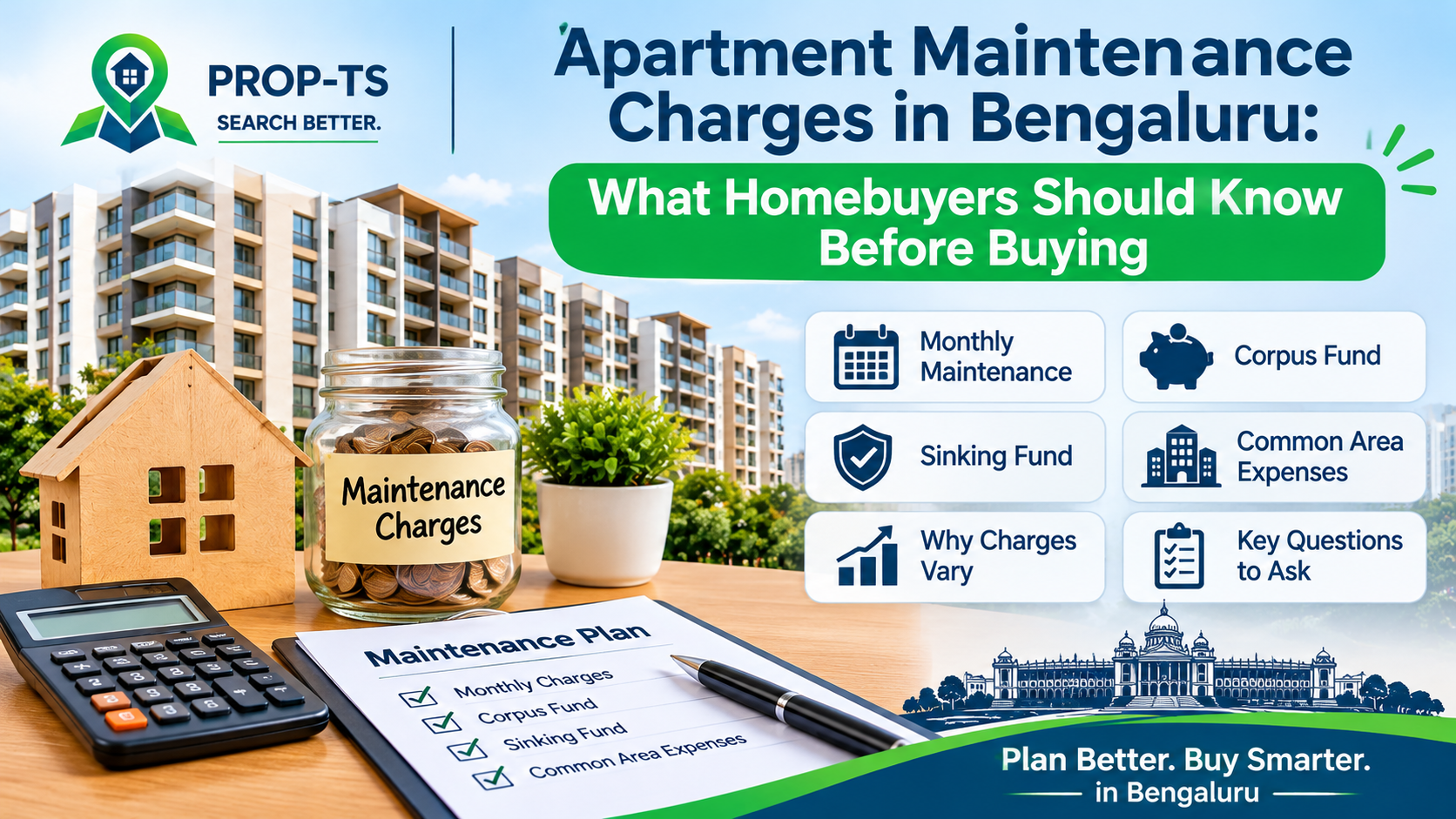
Apartment Maintenance Charges in Bengaluru: What Homebuyers Should Know Before Buying
Introduction
When buying an apartment, most homebuyers focus on the property price, registration expenses, home loan and interiors. However, there is another important cost that continues long after you receive the keys: apartment maintenance.
In a residential community, residents contribute towards the upkeep of shared facilities such as lifts, security systems, gardens, water infrastructure, common lighting and housekeeping.
The amount may vary depending on the size of the apartment, facilities available, number of units and the way the residents' association manages the property.
Before booking an apartment in Bengaluru, it is important to understand what maintenance charges cover, how they are calculated and whether additional funds will be collected.
1. What are apartment maintenance charges?
Apartment maintenance charges are recurring payments collected to operate and maintain the shared facilities and common areas of a residential project.
These payments help keep the community functional, clean and secure.
Depending on the project, maintenance expenses may cover:
- Security personnel and access-control systems
- Housekeeping and common-area cleaning
- Lift operation and maintenance
- Common electricity and lighting
- Water pumps and shared water infrastructure
- Garden and landscape maintenance
- Waste collection and disposal
- Swimming pool and clubhouse upkeep
- Generator and backup power maintenance
- Repairs to shared facilities
The exact services included depend on the project and its maintenance agreement.
2. How are apartment maintenance charges calculated?
There is no single calculation method used by every apartment community.
Common approaches include:
Per-square-foot method
The maintenance amount is calculated based on the apartment's chargeable area. Larger apartments may therefore pay more.
Equal-share method
Each apartment contributes an equal amount, irrespective of its size.
Hybrid method
Some communities combine an equal contribution for certain fixed expenses with an area-based contribution for other costs.
Before booking, ask the developer or association which method applies and whether it is documented in the maintenance agreement or association rules.
3. What is a corpus fund?
A corpus fund is generally a one-time contribution collected to create a financial reserve for the residential community.
The purpose and permitted use of the fund should be clearly explained in the relevant agreement and association records.
Before paying, ask:
- Is a corpus contribution compulsory?
- How much is being collected?
- Is the amount refundable or non-refundable?
- Who will hold and manage the money?
- How will the fund be transferred to the residents' association?
- What expenses can be paid from it?
Do not assume that every project uses the term corpus fund in exactly the same way. Check the written terms.
4. What is a sinking fund?
A sinking fund is a reserve intended to help meet major future repair and replacement expenses.
For example, a residential building may eventually require:
- Major lift component replacement
- External painting
- Terrace and basement waterproofing
- Repairs to common plumbing systems
- Structural maintenance
- Replacement of ageing common equipment
Regular contributions to a sinking fund can help the community prepare for such expenses rather than relying entirely on sudden collections from residents.
Ask whether the project collects a separate sinking fund and how the amount is calculated and managed.
5. Maintenance charges during the initial years
In some projects, the developer arranges maintenance services for an initial period after possession. Later, the residents' association or apartment owners' association may take over the responsibility.
The exact arrangement differs from project to project.
Before booking, clarify:
- Who will maintain the property after possession?
- How long will the developer-managed maintenance period last?
- What happens when that period ends?
- Will the monthly charge change after handover?
- Has a residents' association been formed?
- Will financial records and maintenance contracts be handed over?
These details can help you understand what to expect after moving in.
6. Why do maintenance charges vary between Bengaluru apartments?
Two apartments with similar sizes may have very different maintenance expenses.
Some of the reasons include:
Number of amenities
A project with a clubhouse, swimming pool, gym, landscaped areas and sports facilities may have higher operating expenses.
Size of the residential community
The number of apartments sharing common expenses can influence the amount each household contributes.
Building design and infrastructure
High-rise buildings may have greater lift, fire-safety, pumping and backup-power maintenance requirements.
Water arrangements
Projects that depend on additional water sourcing, treatment and pumping may incur different operating costs.
Staffing and security
The number of security guards, housekeeping staff and facility-management personnel affects the operating budget.
Maintenance contracts
Different service providers and equipment contracts can result in different costs.
For this reason, compare the facilities and services included in the maintenance amount, not just the amount itself.
7. Questions to ask before booking an apartment
Use this checklist when speaking with a builder or sales representative:
- What is the estimated monthly maintenance charge?
- Is the amount calculated per square foot or per apartment?
- Which services are included?
- Are water and power expenses included or billed separately?
- Is there a separate corpus fund?
- Is a sinking fund collected?
- Is there an advance maintenance payment at possession?
- How long will the developer manage maintenance?
- When will the residents' association take over?
- How can residents review maintenance accounts and expenses?
Ask for written details rather than relying only on verbal estimates.
8. How to estimate the long-term maintenance cost
A useful way to understand maintenance is to calculate the potential recurring expense over time.
For example, if an apartment has an illustrative monthly maintenance charge of ₹4,000:
Period Illustrative amount One month: ₹4,000 One year: ₹48,000 and Five years: ₹2,40,000
This example assumes the charge remains unchanged. Actual maintenance may increase over time, and additional contributions may be required for repairs or other expenses.
Use the estimate as a budgeting exercise, not as a prediction of what a particular apartment will charge.
9. Common mistakes homebuyers should avoid
- Considering only the apartment purchase price.
- Not asking for the estimated monthly maintenance amount.
- Assuming all amenities are included in the quoted maintenance.
- Confusing corpus fund and sinking fund contributions.
- Not checking the initial maintenance period.
- Ignoring the handover arrangement between the developer and residents' association.
- Not asking how maintenance charges may be revised.
- Failing to read the maintenance agreement and related documents.
10. Include maintenance in your home-buying budget
Before finalizing an apartment, consider the overall cost of owning and maintaining it.
Your budget should account for:
- Property purchase price
- Stamp duty and registration
- Applicable taxes and other charges
- Home loan expenses
- Interiors and furnishing
- Monthly maintenance
- Utility bills
- Corpus or sinking fund contributions, where applicable
- Future repair and replacement expenses
A home should be comfortable not only to purchase but also to maintain over the years.
Conclusion
Apartment maintenance is an important part of long-term homeownership. Understanding monthly charges, corpus contributions, sinking funds and the maintenance handover process can help you plan your finances more realistically.
When exploring apartments in Bengaluru, compare the facilities, maintenance arrangements and recurring expenses along with the property price and location.
At PROP-TS, we believe that better property decisions begin with better information and the right location.
Search better. Discover properties by location.
Explore properties on the PROP-TS map: https://map.prop-ts.com/
Disclaimer: Maintenance practices, fund structures and charges vary by project and association. This article is for general educational purposes. Review the relevant agreements, budgets and association documents before making a purchase decision.
Explore property opportunities with PROP-TS.
Explore the property map