
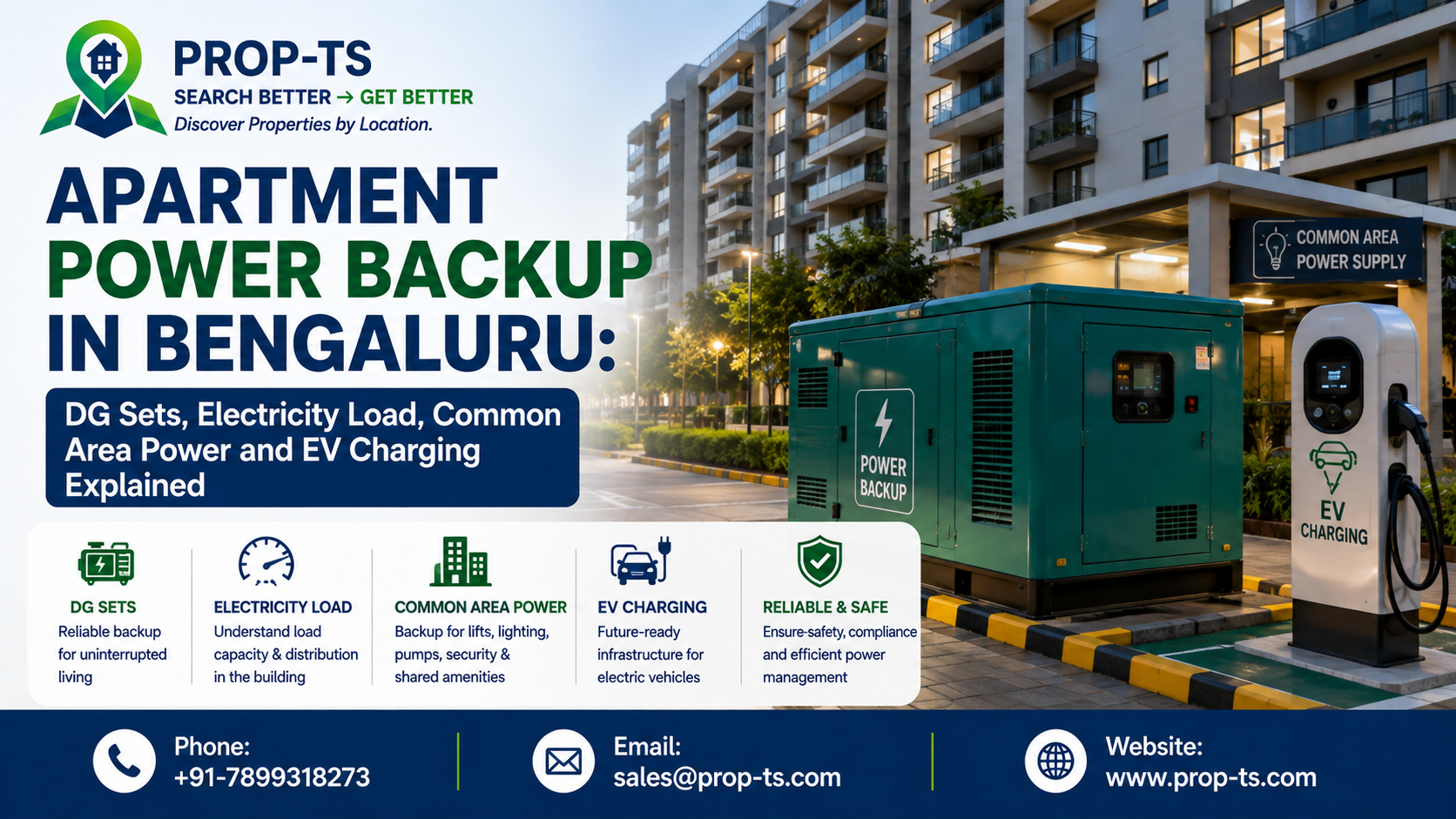
Apartment Power Backup in Bengaluru: DG Sets, Electricity Load, Common Area Power and EV Charging Explained
Electricity is an essential part of comfortable apartment living.
From lifts and water pumps to lighting, security systems, home appliances and internet connectivity, apartment residents depend on reliable electricity every day.
However, many homebuyers focus only on the apartment's interiors, amenities and location without understanding the property's electrical infrastructure.
One important question to ask before booking an apartment in Bengaluru is:
What exactly happens when the BESCOM electricity supply is interrupted?
Some apartments provide backup for selected household circuits, while others provide backup mainly for common facilities. The available backup capacity, generator arrangement and operating limitations can vary considerably between projects.
With increasing use of air conditioners, home appliances and electric vehicles, understanding the apartment's electrical infrastructure has become even more important.
This guide explains what homebuyers should check before purchasing an apartment in Bengaluru.
1. Understand What Apartment Power Backup Means
Apartment power backup refers to the alternative electricity supply available when the normal electricity connection is interrupted.
Depending on the project, backup may be provided through:
- Diesel Generator (DG) sets.
- Battery-based inverter systems.
- Centralised backup systems.
- Individual apartment backup arrangements.
- Hybrid systems combining different technologies.
Not every apartment provides the same level of backup.
For example, one project may provide backup for lifts, water pumps and common-area lighting but offer only limited backup for individual flats.
Another project may provide a dedicated backup arrangement for selected apartment circuits.
Therefore, buyers should understand the actual facilities rather than relying on a general statement such as '100% power backup'.
2. Check Whether Backup Is Available for Individual Apartments
This is one of the most important questions to ask the builder.
Clarify whether backup is available for:
- Selected lights and fans.
- Refrigerators.
- Television and internet equipment.
- Essential electrical sockets.
- Air conditioners.
- Kitchen appliances.
- Water heaters.
Some projects may exclude high-power appliances from backup arrangements.
Ask the builder to provide a written list of supported electrical circuits and appliances.
Do not assume that a statement such as 'power backup available' means every appliance can operate during an electricity interruption.
3. Understand Diesel Generator Capacity
Many large apartment projects use diesel generator sets to support essential electrical loads.
The generator capacity is generally expressed in kVA.
However, the total generator capacity alone does not tell you how much electricity will be available to each apartment.
The available capacity depends on:
- Total connected backup load.
- Number of apartments.
- Common-area electricity requirements.
- Lift and water-pump requirements.
- Diversity and demand calculations.
- Generator operating arrangements.
Ask the builder or project engineer:
- What is the installed DG capacity?
- How many generator sets are installed?
- Are generators configured for automatic changeover?
- What happens if one generator becomes unavailable?
- How is backup capacity distributed among apartments?
- Are there restrictions on high-power appliances?
For a completed apartment, request the equipment details and maintenance records from the association.
4. Understand the Difference Between Flat Backup and Common-Area Backup
Apartment projects have two broad categories of electricity requirements.
Individual apartment requirements
These relate to electricity consumed within the flat.
Examples include lighting, fans, refrigerators and selected sockets.
Common-area requirements
These relate to facilities shared by residents.
Examples include:
- Lifts.
- Staircase lighting.
- Corridor lighting.
- Security systems.
- CCTV cameras.
- Water pumps.
- Sewage Treatment Plants.
- Common-area equipment.
A project may provide reliable common-area backup while offering limited backup to individual apartments.
Ask the builder to explain both arrangements separately.
5. Check the BESCOM Sanctioned Load
The sanctioned load represents the electrical load approved for a particular electricity connection.
A flat with several air conditioners, kitchen appliances, washing machines and other equipment may require more electrical capacity than a basic apartment setup.
Before purchasing, understand:
- The sanctioned load for your apartment.
- Whether the electrical connection is individual or shared.
- Whether the wiring and distribution board are suitable for the intended load.
- Whether additional load enhancement may be required.
- Whether the project's electrical infrastructure supports future requirements.
Buyers should also understand the applicable electricity tariff and billing arrangement.
Do not confuse the total electrical capacity of the apartment project with the sanctioned load available to an individual flat.
6. Check the Electrical Infrastructure and Safety Arrangements
A good electrical installation should be designed, installed and maintained with appropriate safety provisions.
During the site visit, ask about:
- Main electrical panels.
- Distribution boards.
- Earthing arrangements.
- Protective devices.
- Electrical-room access and maintenance.
- Generator safety arrangements.
- Fire-safety provisions.
- Periodic inspections and testing.
Electrical installation work should be carried out by appropriately licensed and competent professionals in accordance with applicable regulations.
The Central Electricity Authority's Measures Relating to Safety and Electric Supply Regulations, 2023, along with applicable amendments, provide the relevant national safety framework.
Homebuyers should not attempt to inspect high-voltage electrical equipment themselves. Seek assistance from a qualified electrical professional where necessary.
7. Ask About Generator Operating Hours and Maintenance
Having a generator does not automatically guarantee uninterrupted backup.
The generator requires regular servicing, fuel and operational monitoring.
Ask the builder or apartment association:
- How frequently are generators serviced?
- Who is responsible for maintenance?
- Is there a preventive maintenance contract?
- Is fuel storage adequate?
- Are operating logs maintained?
- Is there a backup arrangement if the main generator fails?
For ready-to-move apartments, request the maintenance records and understand whether generator expenses are included in the regular maintenance charges or recovered separately.
8. Understand the Electricity Cost of Power Backup
Power backup involves operating expenses.
These may include:
- Diesel consumption.
- Generator servicing.
- Replacement parts.
- Battery replacement, where applicable.
- Operator expenses.
- Electrical maintenance.
- Equipment insurance, where applicable.
Some apartment communities recover generator-related expenses through maintenance charges or a separate backup consumption charge.
Before booking, understand how these costs are calculated.
Ask whether backup electricity is billed according to actual consumption, a fixed arrangement or another documented method.
For resale apartments, ask the association for recent maintenance statements.
9. Check EV Charging Readiness
Electric vehicles are becoming an increasingly relevant consideration for apartment buyers.
Even if you do not currently own an electric vehicle, the availability of appropriate charging infrastructure may influence the property's long-term convenience.
Check:
- Whether EV charging points are already installed.
- Whether dedicated electrical connections are available.
- Whether the sanctioned load can support the proposed charging arrangement.
- Whether individual and community charging options are possible.
- Whether the association has an EV charging policy.
- Whether appropriate safety and fire-protection arrangements are in place.
The Ministry of Power's EV charging infrastructure guidelines recognise arrangements for residential charging and community charging.
A resident or association can explore a separate metered connection through the distribution licensee, subject to the applicable requirements.
In Bengaluru, check the latest BESCOM and KERC requirements before installing charging equipment.
Do not assume that an ordinary parking socket is suitable for EV charging.
10. Check Whether Lifts and Water Pumps Have Backup
Lifts and water pumps are essential services in multi-storey apartment buildings.
During an electricity interruption, inadequate backup arrangements can create significant inconvenience.
Ask:
- Are all lifts connected to generator backup?
- Is there an emergency lift arrangement?
- Are water pumps connected to backup?
- Can overhead tanks continue to be replenished?
- Are sewage-treatment systems supported by backup?
- Is emergency lighting available in staircases?
The builder should explain which services receive priority during an electricity interruption.
11. Documents and Details to Request from the Builder
Before booking an apartment, request relevant electrical infrastructure details.
These may include:
- Electrical layout and single-line diagrams, where available.
- Sanctioned electrical load details.
- Generator specifications and capacity.
- Backup distribution arrangements.
- Electrical safety and testing records.
- Equipment warranties.
- EV charging provisions.
- Maintenance arrangements.
For completed projects, the apartment association may have additional technical records and service contracts.
Review the documents with a qualified professional if you are unsure about their technical meaning.
12. Common Mistakes Homebuyers Should Avoid
Avoid these assumptions:
- Every apartment provides full power backup.
- Generator capacity is the same as individual flat backup.
- All appliances can operate during backup.
- Common-area backup automatically includes flat backup.
- EV charging can be connected to any available socket.
- Generator maintenance is always included in standard maintenance charges.
- A new building automatically has sufficient electrical capacity for future needs.
A clear understanding of the electrical infrastructure can help avoid unpleasant surprises after possession.
13. Apartment Power Backup Checklist
Before booking, check the following:
- Confirm individual apartment backup availability.
- Obtain the list of supported electrical circuits.
- Verify installed DG capacity.
- Understand common-area backup arrangements.
- Check the flat's sanctioned electrical load.
- Review electrical safety provisions.
- Understand generator maintenance arrangements.
- Ask about backup electricity charges.
- Check lift and water-pump backup.
- Review EV charging readiness.
- Request relevant technical documents.
Conclusion
Power backup is an important component of apartment infrastructure.
A property's electrical reliability depends on more than the presence of a generator. Buyers should understand the available backup capacity, distribution arrangements, electrical safety, operating costs and future requirements such as EV charging.
Before booking an apartment in Bengaluru, ask the builder specific questions and obtain written clarification wherever possible.
A few additional checks during the buying process can help you make a more informed decision about the apartment's long-term usability and maintenance requirements.
At PROP-TS, we believe that informed property buyers make better decisions.
PROP-TS — SEARCH BETTER → GET BETTER
Discover Properties by Location.
Explore properties by locality and make better property decisions.
Website: https://www.prop-ts.com
Phone: +91-7899318273
Email: sales@prop-ts.com
Explore property opportunities with PROP-TS.
Explore the property map