
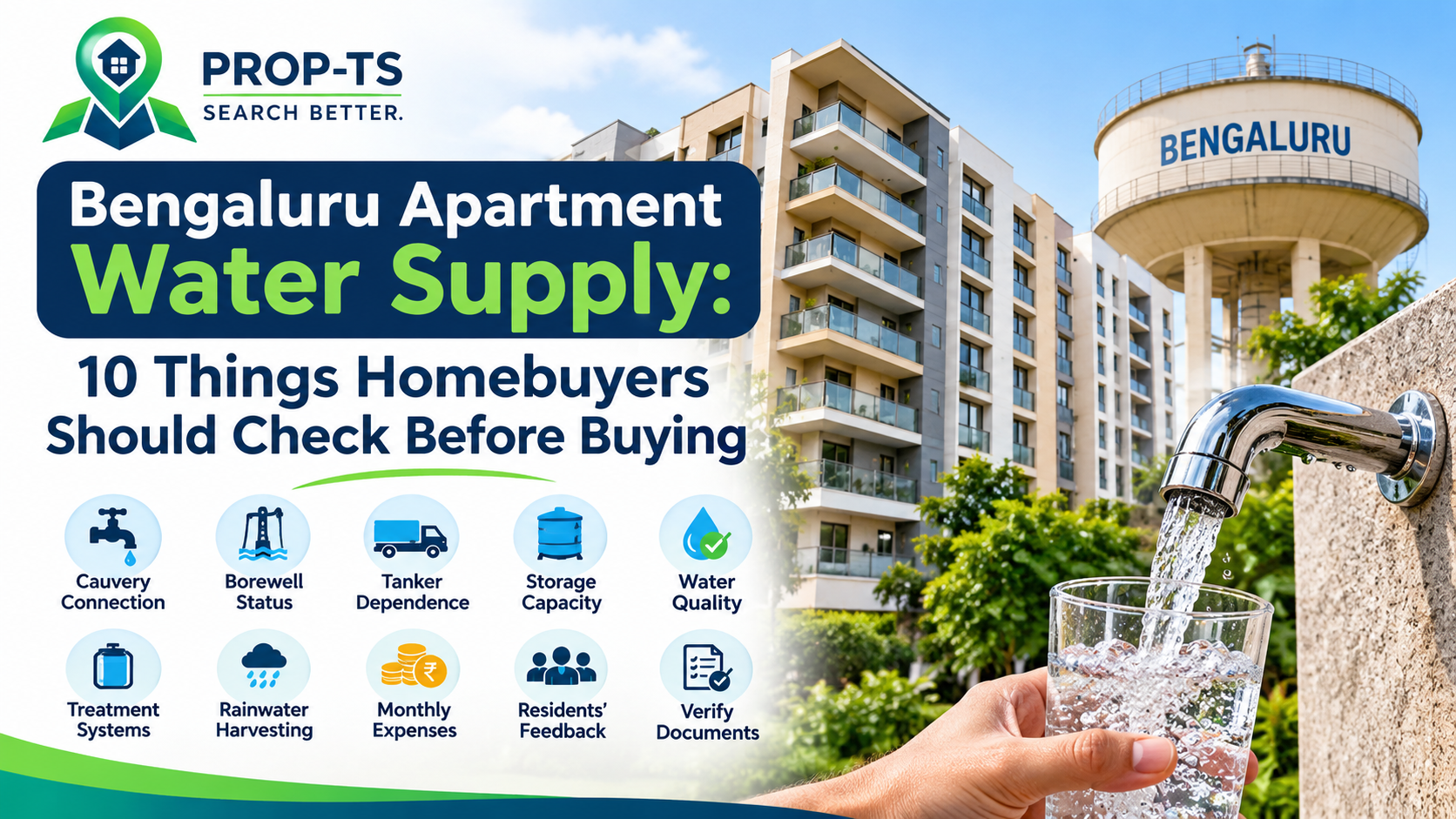
Bengaluru Apartment Water Supply: 10 Things Homebuyers Should Check Before Buying
Introduction
When buying an apartment in Bengaluru, most homebuyers focus on location, price, amenities, connectivity and construction quality.
But there is another important factor that deserves equal attention: water availability.
Water supply can directly affect everyday comfort, monthly household expenses and the long-term maintenance of an apartment.
A residential project may look attractive and offer excellent amenities, but if residents regularly depend on private water tankers or face inconsistent supply, living there can become challenging.
Bengaluru apartments may receive water from different sources, including the Cauvery water supply network, borewells, private water tankers and rainwater harvesting systems.
Before booking an apartment, understand where its water comes from, how consistently it is available and how the building manages its water requirements.
Here are 10 important checks every homebuyer should consider.
1. Check whether the apartment has a Cauvery water connection
The Cauvery water supply network, managed by the Bangalore Water Supply and Sewerage Board (BWSSB), is an important source of municipal water for Bengaluru.
Ask the builder or developer:
- Does the project have an operational BWSSB connection?
- Is the connection available for the entire project?
- Is the connection individual or shared?
- Has the required documentation and approval been completed?
- Is the water supply currently active?
Do not rely only on a sales representative's verbal assurance.
Request relevant connection documents, sanctioned details and recent water bills, wherever applicable.
Also remember that being located in an area with Cauvery water supply does not automatically mean that every apartment building has an active connection.
2. Understand the apartment's dependence on borewells
Some apartment complexes use borewells to supplement their water requirements.
Before purchasing, ask:
- How many borewells are available?
- Are they currently functional?
- What is their approximate water yield?
- How frequently are they used?
- Is the project dependent on borewells during summer?
- Are the required groundwater permissions and records available?
If the builder or association claims that borewells provide sufficient water throughout the year, ask for supporting information.
A borewell's availability does not guarantee a consistent water supply. Its performance can vary depending on groundwater conditions and seasonal changes.
3. Find out how frequently the apartment depends on water tankers
Water tankers can become an important supplementary source when municipal or borewell supplies are insufficient.
However, regular tanker dependence can increase monthly maintenance expenses.
Ask the developer or existing residents:
- How many tankers are required each week?
- Is tanker water used throughout the year?
- How much does the apartment spend on tanker purchases?
- Who arranges the tankers?
- Are suppliers reliable?
- Are water quality checks conducted?
If possible, speak directly with residents rather than depending entirely on information provided by the sales team.
For an under-construction project, ask the developer for its planned water-supply arrangements and estimated operating costs.
4. Check the water storage capacity
Water availability is only one part of the picture. The building must also have sufficient storage and distribution facilities.
Check:
- Underground water sump capacity.
- Overhead tank capacity.
- Number of storage tanks.
- Water pumping arrangements.
- Backup power for essential pumping systems.
- Maintenance and cleaning schedules.
Ask how much water can be stored and whether the storage arrangements are adequate for the project's expected occupancy.
A large apartment complex with inadequate storage may experience supply difficulties even when water is available from its sources.
5. Verify the water quality
Water quality is essential for drinking, cooking, bathing and other household activities.
Do not assume that water is safe simply because it comes from a municipal connection, borewell or tanker.
Ask whether the apartment conducts periodic water-quality testing.
Important parameters to consider include:
- pH level.
- Total Dissolved Solids (TDS).
- Hardness.
- Turbidity.
- Microbiological contamination.
- Other relevant chemical contaminants.
Request recent laboratory test reports, where available.
For drinking water, ask whether the building has an appropriate treatment system and whether the treated water is tested against applicable drinking-water standards.
Also check whether storage tanks are cleaned regularly.
6. Check the water treatment and purification systems
Large residential projects may have water treatment arrangements for different purposes.
Ask whether the apartment has:
- Water filtration systems.
- Softening systems, where required.
- Sewage Treatment Plant (STP).
- Treated wastewater reuse arrangements.
- Separate pipelines for potable and non-potable water.
- Regular maintenance contracts.
Treated wastewater may be reused for suitable non-drinking purposes such as gardening and flushing, subject to appropriate treatment and applicable requirements.
A properly maintained treatment system can help reduce freshwater demand and improve the project's overall water management.
7. Examine the rainwater harvesting system
Rainwater harvesting is an important part of Bengaluru's water-management framework.
The BWSSB Rainwater Harvesting Regulations provide requirements for rainwater collection, storage and groundwater recharge.
Ask the developer:
- Is a rainwater harvesting system installed?
- Is it functional?
- Where is rainwater collected?
- Does the system have suitable filtration?
- Is rainwater stored or used for groundwater recharge?
- Who maintains the system?
Do not consider rainwater harvesting merely as a feature mentioned in the brochure.
Check whether the system has actually been installed and maintained.
8. Understand the actual monthly water expenses
Water-related expenses can affect the monthly maintenance budget.
Ask for an estimate of:
- BWSSB water charges, where applicable.
- Water tanker expenses.
- Borewell electricity consumption.
- Water treatment costs.
- Pump maintenance.
- Storage tank cleaning.
- STP operation and maintenance.
- Water testing expenses.
For an occupied project, request recent maintenance statements if possible.
For a new project, request the developer's estimated operating expenses.
This will help you understand whether the apartment's advertised price is supported by manageable recurring costs.
9. Speak with existing residents about water availability
One of the most useful steps when evaluating a ready-to-move apartment is speaking with people already living in the community.
Ask residents:
- Is water available consistently?
- Are there supply interruptions?
- Does the apartment depend on tankers?
- Are there seasonal water shortages?
- Is drinking water supplied separately?
- Are there frequent water-related complaints?
If possible, visit the apartment more than once and speak to residents from different floors or blocks.
For an under-construction project, request references from the developer's previously completed projects.
10. Verify the water-supply arrangements before signing the agreement
Before booking, collect and review the relevant documents.
Your verification checklist should include:
- BWSSB connection details, where applicable.
- Relevant approvals and permissions.
- Borewell and groundwater-related records, where applicable.
- Rainwater harvesting details.
- Water storage and distribution plans.
- STP and treated-water arrangements.
- Water-quality reports, if available.
- Estimated water-related maintenance expenses.
For under-construction projects, also check the sanctioned plans and the developer's written commitments.
Do not rely entirely on verbal promises made during a property visit.
Final thoughts: Water availability should be part of your property decision
An apartment is not just a purchase of square footage. It is a long-term commitment to a particular location and residential community.
Before choosing a home in Bengaluru, understand its water sources, storage facilities, treatment systems and dependence on external suppliers.
A property with transparent water-management arrangements can help you make a more informed decision about its long-term suitability.
At PROP-TS, we believe that choosing the right home begins with understanding the location and the infrastructure that supports everyday living.
SEARCH BETTER. Discover Properties by Location.
Explore PROP-TS for location-focused property discovery and practical homebuying information.
Disclaimer: This article is for general homebuyer awareness and is not a substitute for project-specific technical, legal or regulatory verification. Requirements may vary depending on the property, location and applicable approvals.
Explore property opportunities with PROP-TS.
Explore the property map