
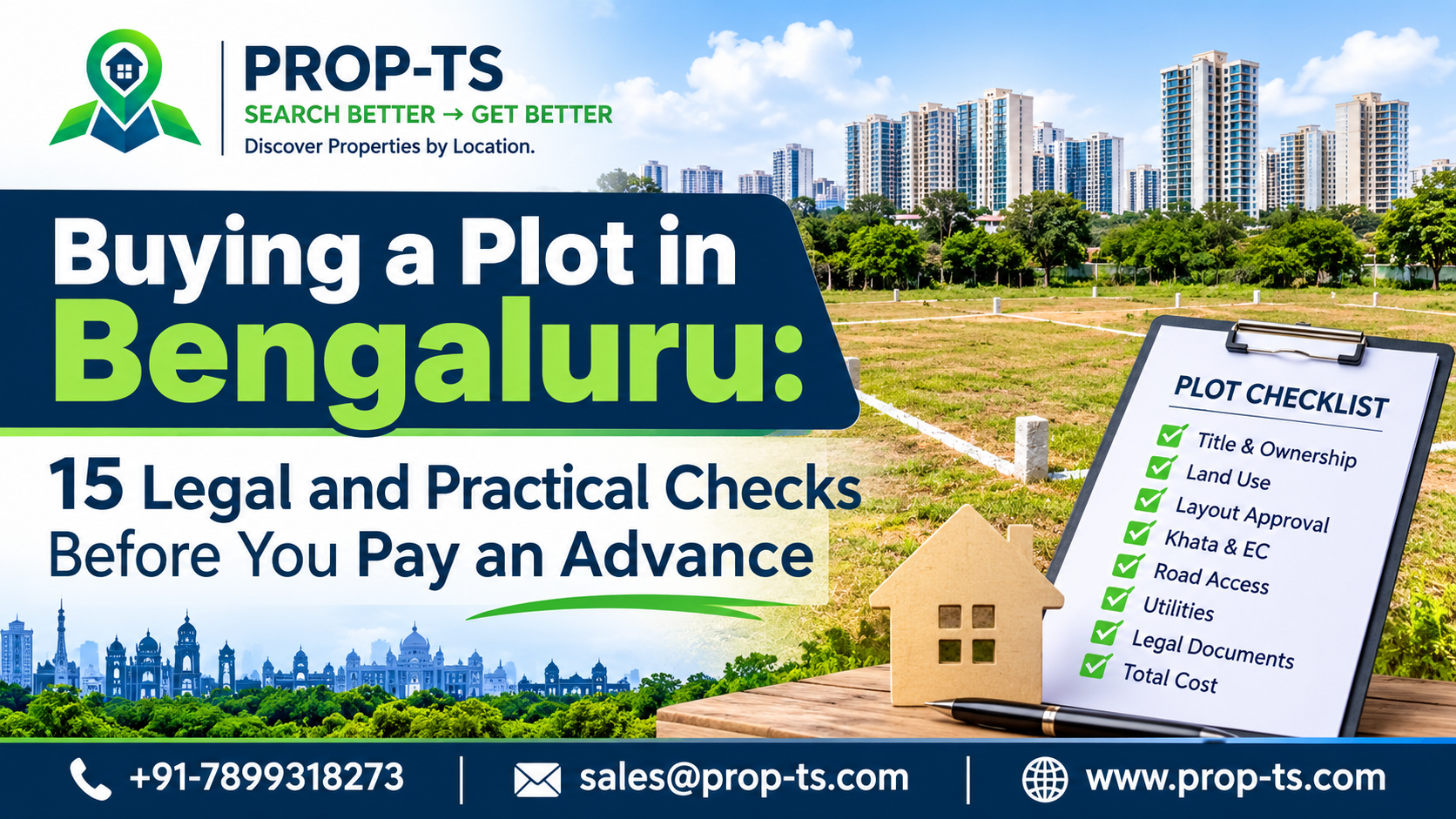
Buying a Plot in Bengaluru: 15 Legal and Practical Checks Before You Pay an Advance
Introduction
Buying a residential plot in Bengaluru can offer flexibility in choosing your home design, construction timeline and future plans. However, purchasing a plot requires a different set of checks compared with buying an apartment.
A plot may appear attractive because of its location, price or promised infrastructure. But before paying a booking amount or advance, buyers must understand the land's ownership, legal status, planning approval, permitted usage and access.
One important point to remember is that a revenue record, khata or tax receipt alone does not establish clear ownership of land.
Whether you are considering a plotted development, an individual residential site or a site on the outskirts of Bengaluru, here are 15 important checks to complete before making a decision.
1. Verify the ownership and title of the land
Start by identifying the legal owner of the land.
Ask the seller for the parent documents and the latest title document. Review how the current owner acquired the property and whether ownership can be traced through the previous transactions.
Check:
- Current owner's name and ownership details.
- Previous sale deeds and parent documents.
- Inheritance, partition or gift documents, where applicable.
- Whether all necessary owners have agreed to the sale.
- Whether the seller has the legal authority to transfer the property.
Have an independent property lawyer examine the title history. Do not depend entirely on documents or legal opinions arranged by the seller.
2. Check whether the land is converted for residential use
Land classification and permitted usage are important.
Agricultural land cannot automatically be treated as an approved residential plot simply because roads or houses have appeared around it.
For land that was originally agricultural, verify whether the required conversion for non-agricultural residential use has been obtained, where applicable.
Ask for the relevant conversion order and have a lawyer verify:
- The survey number and extent of land.
- The name of the landowner.
- The permitted purpose of conversion.
- Whether the order relates to the exact land being offered.
- Whether any conditions attached to the order remain outstanding.
Do not assume that a conversion application or a seller's assurance is equivalent to an issued conversion order.
3. Verify the layout approval
If you are buying a plot in a layout, find out which planning authority approved it.
Depending on the location, the relevant authority may be BDA, BMRDA, a local planning authority or another competent authority.
Request the approved layout plan and verify:
- Approval number and date.
- Survey numbers covered by the approval.
- Total land extent.
- Number and dimensions of approved plots.
- Roads and open spaces.
- Parks and civic amenity areas.
- Whether the plot you are considering appears in the approved plan.
A layout brochure or marketing plan is not a substitute for an approved layout plan.
4. Match the plot number with the approved plan
A common source of confusion is a difference between the plot number shown in a marketing document and the plot number in the approved plan.
Physically identify the plot and match its details with the relevant records.
Check:
- Plot number.
- Dimensions and total area.
- Road-facing direction.
- Adjacent plots.
- Boundaries.
- Survey number and subdivision details, where applicable.
Ask the seller to identify the exact plot on the approved layout plan rather than relying only on a site visit.
5. Obtain and examine the Encumbrance Certificate
An Encumbrance Certificate (EC) helps identify registered transactions and certain registered encumbrances recorded against the property during the period covered by the search.
Review the EC for the relevant survey numbers, property details and ownership history.
Look for:
- Previous sale transactions.
- Registered mortgages.
- Releases of mortgages.
- Registered agreements.
- Other recorded transactions affecting the property.
An EC is an important verification document, but it is not a complete guarantee that the property has a clear title. Some claims, disputes or unregistered arrangements may not appear in it.
Have a lawyer examine the EC together with the title documents.
6. Check for land acquisition and government restrictions
Before buying, verify whether the land is affected by any proposed or completed acquisition, road widening, planning reservation or other government restriction.
Depending on the location, examine relevant records from the competent planning and government authorities.
Ask your lawyer to check for:
- Acquisition notifications.
- Proposed road alignments.
- Master plan reservations.
- Public utility or infrastructure reservations.
- Restrictions affecting the permitted use of the land.
A plot's current physical availability does not necessarily mean it is free from future planning restrictions.
7. Verify the Khata and property tax records
Ask for the applicable khata or property account records and recent property tax receipts.
Check whether the records match the seller's name, property identification and plot details.
However, remember that a khata or property tax record is primarily a municipal or local-body record. It should not be treated as conclusive proof of ownership or layout approval.
Also verify whether the property falls under the jurisdiction of the relevant local authority and whether the records are valid for the property being sold.
8. Confirm the road access
A plot may be legally documented but still have practical access problems.
Visit the property and inspect the approach road.
Check:
- Whether the road physically connects to a public road.
- Whether the access is shown in the approved layout plan.
- Whether the road width matches the relevant approval.
- Whether the road is usable throughout the year.
- Whether access depends on another private owner's land.
- Whether any access disputes exist.
Do not assume that a road shown in a brochure is necessarily an approved or legally secured access road.
9. Inspect the plot boundaries and measurements
Visit the site and compare its physical dimensions with the documents.
Look for boundary stones, compound walls, neighboring structures and any signs of encroachment.
Where necessary, arrange for a qualified surveyor to verify the measurements and boundaries using the relevant survey records.
Confirm:
- Plot length and width.
- Total site area.
- Boundary alignment.
- Neighboring property details.
- Any physical occupation or encroachment.
If the actual dimensions differ from the sale documents, resolve the discrepancy before proceeding.
10. Check for waterlogging and drainage issues
Do not evaluate a plot only during dry weather.
Visit the location during or shortly after rainfall, if possible.
Observe:
- Whether rainwater collects on the plot.
- Whether nearby roads experience waterlogging.
- Whether natural drainage paths are blocked.
- Whether the site is significantly lower than surrounding properties.
- Whether nearby drains have adequate outflow.
Also ask neighboring residents about monsoon conditions and recurring drainage problems.
11. Understand water and electricity availability
Before buying, understand the actual availability of essential services.
Ask the seller:
- Is there an existing electricity connection?
- What is the process for obtaining an individual connection?
- Is a water supply connection available?
- Are borewells or other water sources used in the layout?
- Are underground drainage or sewage facilities available?
- What infrastructure is still pending?
Do not assume that a utility connection is guaranteed merely because it is mentioned in a sales brochure.
12. Check whether the plotted development requires RERA registration
Where a plotted development falls within the scope of the Real Estate (Regulation and Development) Act, 2016, check its applicable RERA registration and disclosures.
Verify the project details through the Karnataka RERA portal.
Compare the registered information with the seller's claims, including the project name, promoter, land details, approvals and development commitments.
RERA applicability depends on the nature and statutory requirements of the project. Do not assume that every individual plot transaction or every layout is automatically covered.
13. Review the sale agreement before paying a substantial amount
Before making a substantial payment, understand the proposed agreement and the seller's obligations.
Check whether the agreement clearly identifies:
- Seller and buyer.
- Property description and survey details.
- Plot dimensions and boundaries.
- Total sale consideration.
- Advance payment and balance payment.
- Payment milestones, if any.
- Possession and registration arrangements.
- Responsibility for pending dues and documentation.
- Conditions for cancellation and refund.
For transactions covered by RERA, also examine the applicable statutory requirements concerning agreements for sale and advance payments.
Have an independent lawyer review the agreement before signing.
14. Understand the complete cost of buying the plot
The advertised plot price may not represent the entire purchase cost.
Prepare a complete estimate that includes:
- Plot sale consideration.
- Applicable stamp duty and registration charges.
- Legal verification expenses.
- Survey and measurement expenses.
- Brokerage, if applicable.
- Applicable taxes or statutory charges.
- Development or infrastructure charges, where applicable.
- Pending property taxes or other dues.
- Future costs for water, electricity and compound construction.
Ask for a written cost sheet and clarify which charges are included in the quoted price.
15. Research the surrounding location and future development
A plot is a long-term investment in a particular location.
Study the surrounding area before deciding.
Consider:
- Distance to employment centers.
- Existing road connectivity.
- Public transport availability.
- Schools and hospitals.
- Grocery stores and daily necessities.
- Existing residential development.
- Current infrastructure conditions.
- Planned infrastructure and its actual approval status.
Treat proposed infrastructure as a possibility rather than a guaranteed future benefit. Verify project status through official sources wherever possible.
Documents to collect before buying a plot
Use this checklist when requesting documents from the seller:
- Latest sale deed or ownership document.
- Parent documents and relevant title history.
- Encumbrance Certificate for the appropriate period.
- Land conversion order, where applicable.
- Approved layout plan and approval details.
- Relevant survey records and land measurement details.
- Khata or applicable property account records.
- Latest property tax receipts.
- RERA registration details, where applicable.
- Relevant access-road and infrastructure records.
- Seller identity and authority documents.
- Draft sale agreement.
The exact documents required will depend on the type, location and legal history of the land.
Common mistakes plot buyers should avoid
- Buying based only on a low price or attractive location.
- Assuming a khata proves clear ownership.
- Treating a marketing layout as an approved layout.
- Not checking land conversion requirements.
- Ignoring the parent documents and title history.
- Paying an advance before legal verification.
- Not physically identifying the exact plot.
- Ignoring road access and drainage.
- Assuming proposed infrastructure will definitely be completed.
- Relying only on verbal promises from the seller.
Final thoughts: Verify the land before investing in it
Buying a plot can be an important step towards building your own home or investing in real estate. But the quality of the decision depends on more than the location and price.
Ownership, land conversion, layout approval, access, boundaries, infrastructure and legal documentation should all be examined before committing your money.
Take time to conduct independent legal and technical verification. A careful review before payment can help reduce avoidable risks later.
At PROP-TS, we believe that better property decisions begin with better information and the right location.
PROP-TS — SEARCH BETTER → GET BETTER
Discover Properties by Location.
Explore property opportunities: https://map.prop-ts.com/
Disclaimer: This article is for general educational purposes and is not legal advice. Land records, approval requirements and planning regulations may vary by location and property type. Verify the latest records with the competent authorities and consult a qualified property lawyer before purchasing.
Explore property opportunities with PROP-TS.
Explore the property map