
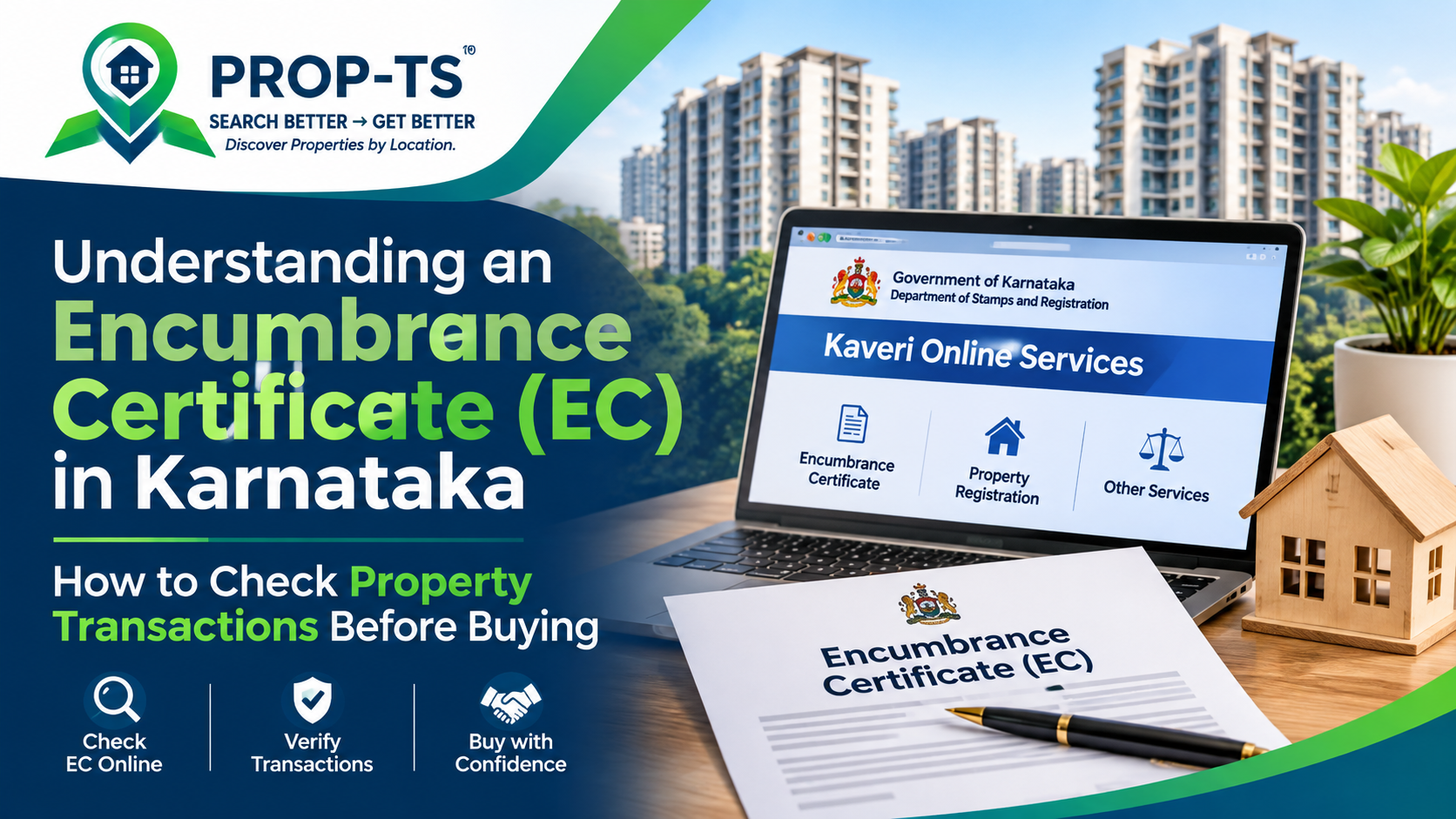
Understanding an Encumbrance Certificate (EC) in Karnataka: How to Check Property Transactions Before Buying
Buying an apartment in Bengaluru involves more than checking the location, amenities, builder reputation and price. One of the important documents a homebuyer should examine before purchasing a property is the Encumbrance Certificate (EC).
An EC helps buyers understand the registered transactions recorded against a property during a specified period. It can provide information about registered sales, mortgages and other transactions that may affect the property.
However, an EC should not be treated as a standalone guarantee of clear ownership or a completely risk-free property.
If you are planning to purchase an apartment, independent EC verification should form part of your wider property due-diligence process.
In this guide, we explain what an EC is, why it matters, how to obtain it through Karnataka's Kaveri portal, what details to examine and what an EC cannot establish.
1. What is an Encumbrance Certificate?
An Encumbrance Certificate is an official document issued through the registration system that provides details of registered transactions relating to a property for a specified search period.
Depending on the records available, an EC may show transactions such as:
- Sale and purchase registrations.
- Registered mortgages.
- Release or discharge of registered mortgages.
- Registered gift deeds.
- Certain registered agreements and other instruments affecting the property.
For a homebuyer, the EC is useful because it helps identify registered transactions that may need further investigation before proceeding with a purchase.
For example, suppose a seller offers you an apartment and claims that the property is free from any loan. An EC search may reveal a registered mortgage relating to the property. You can then ask for the relevant loan-closure and mortgage-release documents.
The important point is that the EC records registered transactions for the property details and period searched. It is not a complete ownership investigation by itself.
2. Why should homebuyers check the EC before buying an apartment?
An apartment purchase usually involves more than the individual flat. It may also involve an undivided share of land, common areas, project-level rights and the underlying land title.
Checking the EC can help you:
Identify registered mortgages
If a mortgage is recorded against the property or underlying land, the buyer should understand who created it, whether it remains outstanding and what documents are required for its release.
Review previous registered transactions
The EC can help trace transactions recorded during the selected period and compare them with the ownership documents provided by the seller.
Identify inconsistencies
Differences in property descriptions, survey numbers, document references or ownership details should be clarified before proceeding.
Support legal due diligence
A property lawyer can use the EC alongside title deeds and other records to investigate the property's transaction history.
Ask better questions before paying
An EC review can reveal issues that need clarification before you pay a booking amount, advance or balance consideration.
3. How to obtain an Encumbrance Certificate online in Karnataka
Karnataka provides online registration-related services through the Kaveri 2.0 portal operated by the Department of Stamps and Registration.
Official portal:https://kaveri.karnataka.gov.in/
The broad process for obtaining an EC online is as follows. Portal screens and service requirements may change, so follow the current instructions displayed on the official website.
Step 1: Open the Kaveri 2.0 portal
Visit the official Kaveri Online Services portal and register or log in using the available login process.
Always check that you are using the official government portal.
Step 2: Select the Encumbrance Certificate service
After logging in, look for the Encumbrance Certificate or Online EC service.
Read the prerequisites and instructions shown on the portal before continuing.
Step 3: Enter the property details
The information required may depend on the type of property and the search method available.
Keep relevant details ready, such as:
- District.
- Taluk.
- Hobli and village, where applicable.
- Survey number and subdivision details, where applicable.
- Property identification number, PID or other available property identifiers.
- Site, assessment or Khata details, where relevant.
Use the details exactly as they appear in the property documents. A mismatch can result in an incomplete or incorrect search.
Step 4: Select the search period
Choose the period for which you want the EC.
Do not select an arbitrary short period simply because it is convenient.
For a purchase, the appropriate search period should be decided with a property lawyer after considering the property's history, previous ownership documents and the nature of the transaction.
Step 5: Review the search results
Check the property description and search period carefully.
Compare the details displayed with the sale deed, previous EC, survey information and other property documents.
If you find a mismatch or an unexpected entry, investigate it before proceeding.
Step 6: Apply for the required signed certificate
Follow the current portal instructions to apply for the digitally signed EC, complete the required authentication and make the applicable payment.
Keep the application reference and payment acknowledgement.
Step 7: Download and preserve the EC
Once the application is processed, download the issued certificate from the portal using the available instructions.
Preserve the original digital file and verify its digital signature or document authenticity using the available official verification facility.
For current service instructions, refer to the Karnataka Department of Stamps and Registration and its Kaveri 2.0 resources.
4. What details should you check in an EC?
Downloading the EC is only the first step. You must examine the information carefully.
Use this checklist:
1. Property identification
Confirm that the EC relates to the exact property you intend to purchase. Check the survey number, site number, PID, village and other identifiers available in the records.
2. Search period
Confirm that the certificate covers the period required for your due-diligence exercise.
3. Owner and party names
Compare the names of sellers, purchasers, mortgagees and other parties appearing in the EC with the relevant registered documents.
4. Registered transaction dates
Review the dates of transactions and their sequence.
5. Document numbers
Note the document numbers, registration dates and Sub-Registrar Office references for entries that need further examination.
6. Mortgage-related entries
Look for mortgage registrations and check whether the corresponding release or discharge documentation is available.
7. Property description
Check whether the property description in the EC corresponds with the sale deed and the property being offered for sale.
8. Unexplained entries
Do not ignore unfamiliar transactions or entries that the seller cannot explain. Obtain copies of the underlying documents and seek professional advice.
5. What is the difference between a Nil EC and an EC showing transactions?
An EC search may return different types of results depending on the registered transactions found during the selected period.
A certificate showing no registered transactions for the specified search parameters is commonly referred to as a Nil EC.
An EC showing registered transactions lists the relevant entries found for the selected property and period.
A Nil EC does not automatically mean that the property has a clear and marketable title.
It only indicates that no relevant registered transactions were found within the search parameters used. If the property details are incorrect, the search period is incomplete or a transaction was not registered, the result may not provide the complete picture.
A certificate containing transactions is not automatically a sign of a problematic property either. A normal sale transaction or a properly discharged mortgage may appear in the records.
The meaning of each entry must be examined in context.
6. What an EC does not prove
This is one of the most important points for homebuyers.
An EC is a record of registered transactions within the search parameters. It does not establish every aspect of the property's legal status.
A clean EC does not, by itself, prove:
- That the seller has a valid and marketable title.
- That there are no pending court cases or disputes.
- That there are no unregistered claims or arrangements.
- That inheritance or succession issues have been properly resolved.
- That all revenue and municipal records are correct.
- That the building has all required approvals.
- That the apartment has been constructed according to the sanctioned plan.
- That there are no unpaid dues or other liabilities outside the scope of the EC search.
For these reasons, an EC must be reviewed along with the title documents, revenue records, Khata details, approvals and other relevant records.
7. EC verification for apartment buyers: Additional checks
When purchasing an apartment in a multi-unit residential project, checking only the individual flat's details may not be sufficient.
The underlying land and the developer's rights over it are also important.
Consider these additional checks:
Underlying land title
Ask for the title documents establishing the ownership and development rights over the land on which the apartment project is constructed.
Development agreement and power of attorney
Where a landowner and developer have entered into a development arrangement, review the relevant registered documents and the developer's authority to develop and sell the apartments.
Land-level mortgage
Check whether the project land has been mortgaged to a bank or financial institution. If so, understand the applicable release or lender consent requirements for the specific apartment being purchased.
Undivided share of land
Verify the undivided share (UDS) proposed to be conveyed to you and ensure it is consistent with the sale documentation and legal advice.
Previous ownership and transaction history
Check whether the ownership chain and registered transactions are consistent with the seller's claims and the documents being provided.
These checks are particularly important in large apartment developments, where the land, development rights and individual apartment transactions may involve different documents.
8. Common mistakes buyers should avoid
Avoid these mistakes when checking an EC:
- Accepting a screenshot instead of obtaining and verifying the issued certificate.
- Checking an EC for the wrong survey number or property identifier.
- Searching only a very short period without legal advice.
- Assuming a Nil EC guarantees clear title.
- Ignoring mortgage entries.
- Failing to obtain the documents behind unfamiliar transactions.
- Checking the apartment without reviewing the underlying land records.
- Assuming that a bank's loan approval replaces independent legal due diligence.
A little additional verification before booking can help you identify questions that may otherwise arise much later.
9. Documents to review along with the EC
A homebuyer should generally ask a qualified property lawyer to review the applicable documents, which may include:
- Current and previous sale deeds.
- Mother deed or relevant title-chain documents.
- Encumbrance Certificate for an appropriate period.
- Khata or e-Khata documents, as applicable.
- Relevant revenue records and mutation details.
- Conversion and development-related permissions, where applicable.
- Sanctioned building plan and relevant approvals.
- Karnataka RERA registration details, where applicable.
- Occupancy Certificate, where applicable.
- Mortgage release or lender NOC documents, where required.
- Tax and other relevant payment records.
The exact documents required depend on the property type, location, ownership history and transaction structure.
10. Frequently Asked Questions
Is an Encumbrance Certificate mandatory when buying an apartment in Bengaluru?
An EC is an important part of property due diligence and is commonly requested during property transactions and home-loan processing. The exact requirements may depend on the lender, transaction and legal review.
Can I download a Karnataka EC online?
Yes. Karnataka provides an online EC service through the Kaveri 2.0 portal. Visit https://kaveri.karnataka.gov.in/ and follow the current service instructions.
Does a Nil EC mean that the property has no legal problems?
No. A Nil EC indicates that no relevant registered transactions were found for the property details and period searched. It does not establish clear title or rule out every possible dispute or claim.
How many years of EC should I check?
There is no single search period that is appropriate for every property. The period should be determined after reviewing the property's title chain and transaction history with a qualified property lawyer.
Does an EC show whether a property has a pending court case?
An EC is not a comprehensive court-record search. Buyers should arrange separate litigation and title due diligence where appropriate.
Should I check the EC for the apartment or the land?
For an apartment purchase, the underlying land and the individual apartment transaction both matter. Your lawyer should determine the appropriate property identifiers and records to be searched.
Can a bank-approved apartment be considered legally safe?
Not automatically. A lender's checks are part of its lending process and do not replace the buyer's independent legal due diligence.
Conclusion
An Encumbrance Certificate is an important document to examine before buying an apartment in Bengaluru or elsewhere in Karnataka.
It can help you understand registered property transactions, identify mortgage-related entries and ask important questions about the property's history.
But remember: a clean EC is not the same as a clear property title.
Review the EC alongside the title chain, land records, Khata details, approvals and other relevant documents. Seek an independent legal opinion before making a major financial commitment.
At PROP-TS, we believe that a better property decision begins with better information.
PROP-TS — SEARCH BETTER → GET BETTER
Discover Properties by Location.
Explore property opportunities with PROP-TS.
Explore the property map