
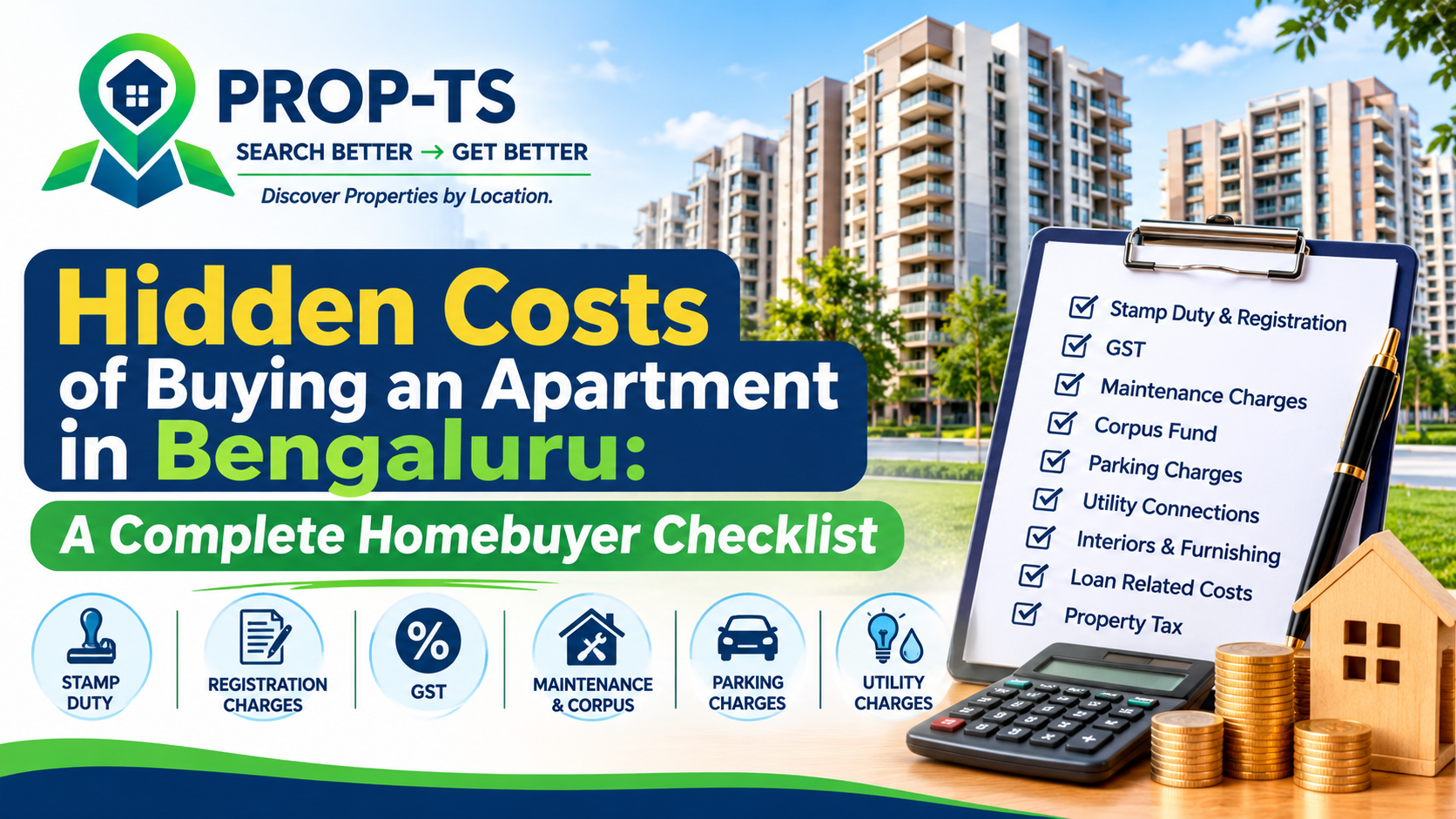
Hidden Costs of Buying an Apartment in Bengaluru: A Complete Homebuyer Checklist
When you start looking for an apartment in Bengaluru, the first number you usually compare is the base price. A builder may advertise a 2 BHK apartment for ₹75 lakh or a 3 BHK for ₹1.2 crore, making it easy to compare projects.
But the advertised price is not always the final amount you need to arrange.
Apart from the apartment's base price, buyers may need to budget for stamp duty, registration charges, GST where applicable, maintenance deposits, corpus contributions, parking, utility connections, interiors and loan-related expenses.
These additional costs can make a significant difference to your overall budget.
Before booking an apartment, understand the complete cost structure. This guide explains the common additional expenses homebuyers should check when buying a flat in Bengaluru.
1. Base price: Understand what is included
The base price is usually calculated using the apartment's saleable or super built-up area multiplied by the quoted rate per square foot.
For example:
- Apartment area: 1,200 sq. ft.
- Quoted rate: ₹6,500 per sq. ft.
- Indicative base price: ₹78,00,000
However, do not assume that this is the final agreement value.
Ask the builder for a detailed cost sheet that clearly separates:
- Base apartment price
- Floor-rise or preferential-location charges, if any
- Parking charges, if applicable
- Clubhouse or amenity-related charges
- Applicable taxes
- Maintenance and corpus contributions
- Stamp duty and registration estimates
Compare the total cost of similar apartments, not just the advertised rate per square foot.
2. Stamp duty in Karnataka
Stamp duty is a government charge payable on property transactions. It is an important part of the purchase budget and is generally calculated with reference to the property's value under the applicable valuation rules.
For many Bengaluru apartment purchases above ₹45 lakh, the commonly applicable basic conveyance stamp-duty rate is 5%, with applicable cess and surcharge components.
The exact amount depends on the property's classification, location, valuation and applicable rules.
Before budgeting, confirm the current calculation using the Karnataka registration system or a qualified registration professional.
Do not rely only on the builder's estimate. Ask for a clear breakup of the stamp duty and the value on which it has been calculated.
3. Property registration charges
Registration charges are separate from stamp duty.
Karnataka revised its registration fee from 1% to 2%, effective 31 August 2025, through a Revenue Department notification.
For a typical Bengaluru apartment transaction above ₹45 lakh, the combined stamp duty, applicable cess and surcharge, and registration fee can work out to approximately 7.6% of the relevant property value.
Illustrative example for a ₹1 crore apartment:
For an apartment with an illustrative property value of ₹1 crore, the estimated charges would be:
- Stamp duty and applicable cess/surcharge (approximately 5.6%): ₹5,60,000
- Registration fee (2%): ₹2,00,000
Total estimated stamp duty and registration charges: ₹7,60,000.
This is an illustration, not a final government assessment. The actual amount must be calculated using the applicable guidance value, transaction value and current registration rules.
Use the official Karnataka RERA and government services for project-related checks and the Karnataka Kaveri registration portal for registration-related services and current calculations.
4. GST on under-construction apartments
GST treatment depends on the stage and nature of the property transaction.
Under the current general concessional residential construction rate structure:
- Non-affordable residential apartments generally attract 5% GST without input tax credit.
- Qualifying affordable residential apartments generally attract 1% GST without input tax credit.
For the concessional affordable-housing definition, the applicable conditions include a carpet area limit of 60 square meters in metropolitan cities and a value limit of ₹45 lakh. Bengaluru is included among the metropolitan cities for this purpose.
A ready-to-move apartment is generally outside GST where the entire consideration is received after the completion certificate, where required, or after first occupation, whichever is earlier.
What should buyers check?
- Is the apartment under construction or ready to move?
- Has the applicable completion certificate been issued?
- Has the building been occupied?
- What GST treatment has the builder applied?
- Is the tax amount shown separately in the cost sheet?
- Does the project's tax treatment require a special assessment?
Do not assume that every apartment attracts the same GST rate. Older projects and specific project circumstances may require separate tax analysis. Ask the builder for the tax basis and have the calculation checked by a qualified tax professional.
5. Advance maintenance charges
Many builders collect maintenance charges in advance before handing over possession or for an initial period after possession.
These charges may cover:
- Security services
- Housekeeping
- Common-area electricity
- Lift maintenance
- Garden and landscape maintenance
- Swimming pool and clubhouse upkeep
- Common-area repairs
- Facility management services
Ask the builder:
- What is the monthly maintenance rate per square foot or per apartment?
- For how many months is the advance collected?
- When does the maintenance period begin?
- Who manages the property before the owners' association takes over?
- How will unused advance amounts be accounted for?
Also ask whether GST or other applicable taxes are included in the quoted maintenance amount.
6. Corpus fund and sinking fund
Some residential projects collect a corpus contribution or sinking-fund amount from buyers.
These funds may be intended to support long-term common-area maintenance, major repairs and future replacement of shared infrastructure, depending on the project's documents and association arrangements.
Before paying, clarify:
- The amount collected per apartment
- Whether the contribution is one-time or recurring
- The purpose of the fund
- Who holds and manages the money
- Whether the fund will be transferred to the owners' association
- How the balance and utilization will be reported
Do not treat a corpus contribution and advance maintenance as interchangeable. Ask for separate line items and written explanations.
7. Parking charges
Parking is an important consideration, particularly in large apartment communities.
The cost sheet may mention parking-related amounts, but buyers should understand exactly what is being offered.
Ask the builder:
- Is a parking space included in the apartment price?
- What type of parking is being provided?
- Is it a covered parking space or another permitted arrangement?
- Is the space allotted to the specific apartment?
- Is the location shown in the parking plan?
- Are any additional parking-related payments being requested?
Check the agreement and applicable legal provisions before accepting a separate parking charge. The treatment of open parking, covered parking and garages is not identical under RERA and other applicable laws.
8. Clubhouse, amenities and infrastructure charges
Modern apartment projects often advertise facilities such as:
- Gymnasium
- Swimming pool
- Indoor games
- Multipurpose hall
- Children's play area
- Sports courts
- Walking tracks
- Landscaped gardens
- Community spaces
Some projects include these facilities in the base price, while others show separate charges for clubhouse membership, amenities or infrastructure.
Ask for a written list of what is included in the apartment price and what is billed separately.
Also check whether any recurring membership or usage fees will apply after possession.
9. Electricity, water and utility connection charges
Utility-related expenses may appear as separate items in the builder's cost sheet.
These can include charges relating to:
- Electricity connection or meter
- Water connection
- Sewage and drainage infrastructure
- Power backup or generator facilities
- Other applicable utility deposits
Ask whether these amounts are actual authority or service-provider charges, builder-collected deposits or infrastructure contributions.
Request a breakup and supporting basis for each amount. Do not assume that a utility charge is included simply because the apartment is advertised as ready to move.
10. Interior work and furnishing expenses
An apartment may be ready for possession but still require considerable spending before you can move in comfortably.
Common expenses include:
- Modular kitchen
- Wardrobes
- Lighting and electrical fittings
- Fans and other fixtures
- Curtains and blinds
- Bathroom accessories
- Storage units
- Painting or additional finishing
- Furniture and appliances
If you are buying an unfurnished apartment, prepare a separate interiors budget.
Visit the actual unit or a representative completed apartment to understand what is included in the builder's specifications and what you will need to arrange yourself.
11. Home loan processing and related expenses
If you are financing the purchase through a home loan, remember to budget for costs beyond the down payment and EMI.
Depending on the lender and loan product, these may include:
- Loan processing fee
- Legal and technical evaluation charges
- Documentation or administrative charges
- Applicable mortgage or security-document registration and stamp charges
- Property insurance, if selected or required under the lender's terms
- Other lender-specific fees
Ask the bank for a written list of charges before accepting the loan offer.
Compare the interest rate, processing fee, repayment conditions and other terms rather than choosing a loan based only on the advertised EMI.
12. TDS on property purchases
For qualifying property transactions, buyers must also consider tax deducted at source under Section 194-IA of the Income-tax Act.
Generally, when the consideration for a property or its stamp-duty value, as applicable under the provision, is ₹50 lakh or more, the buyer is required to deduct TDS at 1% when paying a resident seller, subject to the statutory rules.
TDS is normally deducted from the amount payable to the seller and deposited with the government. It is not an additional 1% purchase charge on top of the agreed price, but it is an important compliance and payment-planning requirement.
The rules differ in certain situations, including transactions involving non-resident sellers. Confirm the applicable process with a tax professional.
13. Property tax and post-possession expenses
Once you take possession, there may be recurring expenses to plan for.
These can include:
- Property tax
- Monthly maintenance
- Electricity and water consumption
- Internet and other utility bills
- Clubhouse or facility charges, if applicable
- Repairs within the apartment
- Home insurance, if chosen
Ask when property-tax responsibility begins under the agreement and applicable local rules. Also check whether any outstanding dues need to be cleared before handover.
14. Brokerage and other professional charges
If you have purchased through a real estate agent or channel partner, check whether brokerage is payable by you and, if so, how it is calculated.
Other professional expenses may include:
- Independent legal document review
- Property valuation
- Tax consultation
- Technical inspection
- Interior design consultation
These services can help you understand the transaction, but confirm the fee and scope of work before engaging a professional.
15. Complete homebuyer cost checklist
Use this checklist before finalizing your apartment purchase.
Government and transaction costs
- Stamp duty
- Registration fee
- Applicable cess and surcharge
- GST, where applicable
- TDS compliance, where applicable
Builder and apartment-related costs
- Base apartment price
- Floor-rise or location charges
- Parking-related charges, where legally applicable
- Clubhouse or amenity charges
- Utility and infrastructure charges
- Advance maintenance
- Corpus or sinking fund
Financing and moving-in costs
- Home loan processing and related fees
- Legal and technical verification
- Interiors and furnishing
Moving expenses
- Initial repairs or additional fittings
Recurring expenses
- Monthly maintenance
- Property tax
- Electricity and water
- Other recurring facility charges
16. How to compare the real cost of two apartments
Suppose you are comparing two apartments with similar advertised prices.
Project A may quote a lower base price but charge separately for parking, clubhouse access and other items. Project B may quote a slightly higher base price but include more facilities.
The better comparison is not simply the base price per square foot.
Prepare a side-by-side cost sheet containing:
- Base apartment price
- All builder charges
- Applicable GST
- Estimated stamp duty and registration
- Advance maintenance and corpus
- Loan-related expenses
- Estimated interiors and moving costs
Then compare the overall amount you need to pay before taking possession, along with the expected recurring costs.
This gives you a clearer picture of affordability and helps avoid last-minute financial surprises.
Conclusion: Calculate the complete cost before booking
Buying an apartment in Bengaluru involves more than arranging the down payment and calculating the monthly EMI.
Stamp duty, registration charges, GST where applicable, maintenance deposits, corpus contributions, parking, utility charges, interiors and loan-related expenses can all affect your final budget.
Before booking, request a detailed cost sheet from the builder, verify each charge, understand the applicable taxes and keep a separate contingency amount for expenses after possession.
At PROP-TS, we believe a better property decision begins with better information and a better understanding of the location.
PROP-TS — SEARCH BETTER → GET BETTER
Discover Properties by Location.
Explore available properties by location at https://map.prop-ts.com/ and compare your options with greater clarity.
Disclaimer: This article is for general awareness and educational purposes, not legal, tax or financial advice. Stamp duty, registration charges, GST and TDS depend on the transaction, property, location, applicable law and current government rules. Confirm the final amounts with the relevant authorities and qualified professionals before making payment.
Explore property opportunities with PROP-TS.
Explore the property map