
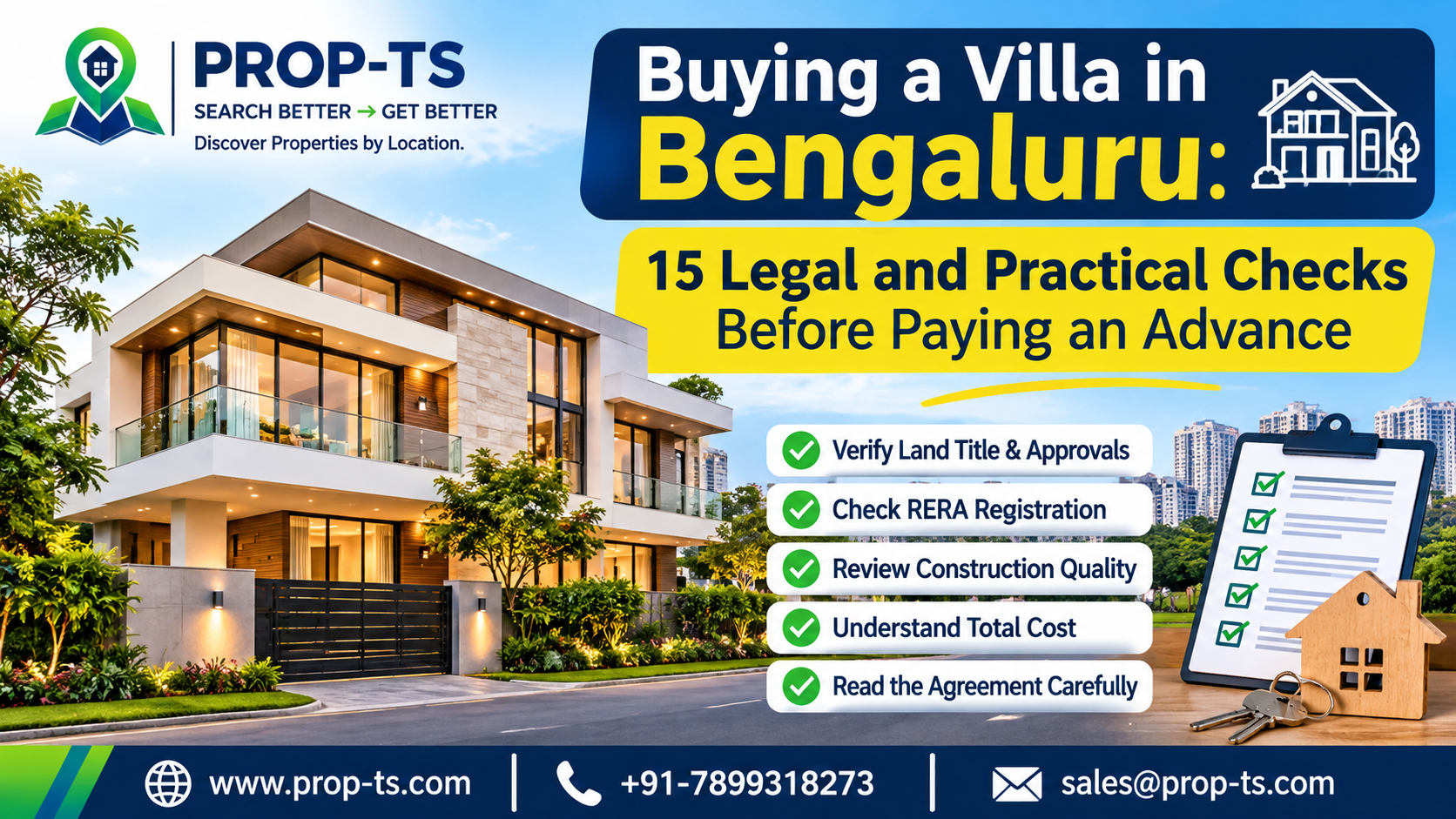
Buying a Villa in Bengaluru: 15 Legal and Practical Checks Before Paying an Advance
Buying a villa in Bengaluru is an important financial and lifestyle decision. Compared with an apartment, a villa can offer greater privacy, independent living space, a private garden, parking and access to shared gated-community facilities.
However, buying a villa also involves several additional checks relating to land ownership, layout approvals, construction permissions, property boundaries, common infrastructure and legal documentation.
Whether you are considering a luxury villa in North Bengaluru, a gated community near Sarjapur Road, a property around Whitefield, or a villa in Electronic City, do not make your decision based only on the sample villa, brochure or advertised price.
A carefully planned villa purchase should establish three things:
- Whether the land and property have a legally verifiable ownership history.
- Whether the layout and construction have the necessary approvals.
- Whether the actual property, facilities and financial commitments match what the developer or seller has promised.
Here are 15 important checks before buying a villa in Bengaluru.
1. Understand What You Are Actually Buying
Before examining documents, understand the ownership structure of the villa.
A villa purchase may involve:
- Ownership of an individual plot and the building constructed on it.
- Ownership within a plotted development with shared infrastructure.
- A row house or villa in a common development with shared roads and facilities.
- An independent house on an individually owned site.
These arrangements can have different ownership structures and responsibilities.
Ask the seller or developer:
- Is the land individually conveyed to the villa owner?
- Is there an undivided share of land?
- Are roads, parks and clubhouses common areas?
- Who owns and maintains the shared infrastructure?
- Are there restrictions on future construction or modifications?
Get the ownership structure clearly documented in the agreement and sale deed.
2. Verify the Land Title and Ownership History
Land ownership is one of the most important aspects of a villa purchase.
Request the mother deed, previous sale deeds and supporting documents establishing the ownership chain.
Ask a qualified property lawyer to examine the title history, preferably covering approximately 30 years where records are available and appropriate.
Check:
- Whether the seller or developer has a valid title.
- Whether previous ownership transfers are properly documented.
- Whether there are disputes involving previous owners.
- Whether the property has been inherited or transferred through a gift or partition.
- Whether the person signing the agreement has authority to sell.
For a developer-led project, also verify how the developer obtained development rights over the land.
Do not rely only on a photocopy of the latest sale deed.
3. Check the Agricultural Land Conversion Status
Some villa developments around Bengaluru are located on land that was previously classified as agricultural.
Where applicable, verify the land-use conversion order issued by the competent authority under the applicable Karnataka land-revenue framework.
Check:
- Whether the original land was agricultural.
- Whether the required conversion has been obtained.
- Whether the conversion permits the intended residential use.
- Whether all relevant conditions have been complied with.
- Whether the survey numbers match the project land.
A conversion document for one survey number should not automatically be treated as proof for adjoining survey numbers.
Ask your lawyer to verify the complete project land.
4. Verify the Approved Layout Plan
A villa development should have the appropriate layout approvals from the competent planning authority.
Depending on the location and jurisdiction, the relevant authority may be BDA, BMRDA, a local planning authority or another competent body.
Request the approved layout plan.
Check whether:
- Your villa's plot number is included in the approved layout.
- The plot dimensions match the actual property.
- Internal roads are approved.
- Parks and open spaces are correctly identified.
- Civic amenity areas are properly marked.
- Drainage and utility areas are accounted for.
- The developer has made unauthorised modifications to the approved layout.
Never assume that a gated community is legally approved simply because roads, landscaping and villas have already been constructed.
5. Check Karnataka RERA Registration
Karnataka RERA registration is an important verification step for eligible residential projects.
Under RERA, registration generally applies to projects exceeding the prescribed thresholds of 500 square metres of land area or more than eight apartments, subject to the Act's provisions and exemptions.
Do not assume that a project is exempt merely because the developer describes it as a villa development.
Visit the Karnataka RERA portal:
https://rera.karnataka.gov.in/
Check:
- Project registration number.
- Developer and promoter details.
- Project land and location.
- Approved project plans.
- Proposed completion date.
- Quarterly progress updates.
- Extensions and complaints, where available.
- Phase-specific registration details.
Make sure the villa you are purchasing belongs to the registered project or phase.
6. Verify the Sanctioned Building Plan
An approved layout does not automatically mean every villa has been constructed with the required building permissions.
Ask for the sanctioned building plan applicable to your villa.
Compare the approved plan with the actual construction.
Check:
- Number of floors.
- Built-up area.
- Setbacks.
- Building height.
- Parking provision.
- Balcony and terrace areas.
- Permitted construction usage.
Unapproved construction or significant deviations may create problems during occupancy certification, financing and resale.
If you are purchasing an independent villa, have the actual measurements and boundaries independently checked.
7. Check Khata and Municipal Property Records
Khata records are important for municipal property identification and tax assessment.
Request the applicable Khata certificate and extract, including e-Khata where relevant.
Verify:
- Owner's name.
- Property identification details.
- Survey number or site number.
- Property dimensions.
- Assessment details.
- Corresponding tax records.
For properties outside municipal corporation limits, check the applicable local-body records.
Remember that Khata is not a substitute for a valid ownership title, approved layout or building permission.
8. Obtain an Encumbrance Certificate
An Encumbrance Certificate (EC) helps identify registered transactions and encumbrances recorded against a property during the requested period.
Obtain a recent EC and have your lawyer review an appropriate historical period, often 30 years where records are available.
Check for:
- Registered mortgages.
- Previous sale transactions.
- Registered agreements.
- Release deeds.
- Other recorded charges or interests.
If the project land has been mortgaged to a bank or financial institution, obtain the relevant release documentation or unit-specific NOC where required.
An EC does not reveal every possible dispute or unregistered claim, so it should form part of broader legal due diligence.
9. Inspect the Actual Villa Construction Quality
A beautifully designed sample villa does not guarantee that the completed property will have the same construction quality.
During your site visit, examine:
- Foundation and visible structural conditions.
- Walls, columns and beams.
- Roof and terrace waterproofing.
- Bathroom and kitchen plumbing.
- Electrical wiring and distribution boards.
- Doors and windows.
- Flooring and finishing.
- Staircase safety.
- Ventilation and natural lighting.
Look for cracks, seepage, uneven flooring, dampness and poor finishing.
For a completed or substantially constructed villa, consider engaging an independent civil or structural engineering professional to inspect the property.
10. Verify Water, Electricity and Sewage Infrastructure
Water and utility infrastructure can have a major impact on everyday living.
Ask the developer:
- Is the property connected to BWSSB where applicable?
- Is borewell water being used?
- Is treated water available?
- Is there a functioning sewage treatment plant where required?
- Are rainwater harvesting systems installed?
- Is the BESCOM connection approved?
- What is the sanctioned electrical load?
- Are backup power facilities available?
For larger developments, inspect the common infrastructure rather than relying only on the villa's individual connections.
Ask for actual operating arrangements and recurring costs.
11. Examine Roads, Access and Connectivity
A villa's location influences its daily convenience and future marketability.
Evaluate:
- Access to the nearest major road.
- Road width and condition.
- Public transport connectivity.
- Distance to workplaces.
- Access to schools and hospitals.
- Grocery and daily-needs facilities.
- Traffic conditions during peak hours.
- Future infrastructure proposals.
Check whether the access road is legally documented and whether the development has permanent, adequate access.
Do not assume that a proposed metro station or future road project will be completed on the advertised timeline.
12. Understand Common Areas and Community Management
In a gated villa community, shared facilities can include:
- Internal roads.
- Parks and landscaped areas.
- Clubhouses.
- Swimming pools.
- Security infrastructure.
- Gymnasiums.
- Sewage treatment facilities.
- Water treatment facilities.
Find out who owns these facilities and who will manage them after handover.
Ask whether a residents' association or other appropriate management arrangement exists or is proposed.
Also verify the applicable maintenance charges, corpus contributions, sinking funds and rules governing common facilities.
13. Check the Complete Purchase Cost
The advertised villa price is not necessarily the final amount you will pay.
Request a detailed cost sheet covering:
- Basic villa price.
- Plot or land component, where applicable.
- Parking charges, if legally chargeable.
- Clubhouse and amenity charges.
- Infrastructure charges.
- Maintenance deposits.
- Corpus contributions.
- Stamp duty and registration.
- Applicable GST for under-construction properties.
- Legal and loan-processing expenses.
- Interior and furnishing expenses.
Compare the complete cost of two or three similar projects instead of comparing only their advertised base prices.
Verify the applicable taxes and registration charges at the time of transaction.
14. Read the Agreement and Payment Schedule Carefully
Do not sign an agreement simply because the developer is offering a limited-period discount.
Check:
- Exact plot and villa identification.
- Carpet or usable area and other area descriptions.
- Construction specifications.
- Payment milestones.
- Possession date.
- Delay-related provisions.
- Cancellation and refund conditions.
- Maintenance responsibilities.
- Common-area rights.
- Defect-liability provisions.
- Registration obligations.
For under-construction properties, examine whether payments are appropriately linked to documented construction milestones.
Avoid making large payments based only on verbal promises.
Have a property lawyer review the agreement before signing.
15. Verify Completion, Occupancy and Handover Documents
For a completed villa, ask for the applicable completion and occupancy documents issued by the competent authority.
Check whether the construction matches the sanctioned plan and whether any required certificate is missing.
For under-construction villas, establish in writing which approvals and certificates will be provided before possession.
Also request:
- Final approved plans.
- Property tax records.
- Utility connection details.
- Warranty information.
- Construction specifications.
- Keys and access arrangements.
- Maintenance and association handover documentation.
- Outstanding dues statement.
Do not treat a possession letter or electricity connection as a substitute for the required statutory occupancy documentation.
Popular Villa Locations to Explore in Bengaluru
Depending on your budget, lifestyle and commute requirements, you may explore villa opportunities in different parts of Bengaluru.
North Bengaluru
- Devanahalli
- Yelahanka
- Thanisandra
- Jakkur
East Bengaluru
- Whitefield
- Budigere
- Hoskote
- KR Puram
South and Southeast Bengaluru
- Sarjapur Road
- Electronic City
- Chandapura
- Attibele
West Bengaluru
- Mysore Road
- Kengeri
- Magadi Road
These are location suggestions, not investment rankings. Evaluate each individual project's approvals, price, access, infrastructure and actual connectivity.
Common Mistakes to Avoid When Buying a Villa
- Paying an advance without checking the title.
- Assuming all gated communities have approved layouts.
- Ignoring land conversion requirements.
- Failing to check RERA registration applicability.
- Confusing Khata with legal ownership.
- Accepting verbal promises about amenities.
- Ignoring common-area ownership and maintenance.
- Comparing only the advertised villa price.
- Overlooking construction deviations.
- Signing agreements without independent legal review.
Frequently Asked Questions
1. Is buying a villa in Bengaluru better than buying an apartment?
It depends on your budget, lifestyle and priorities. Villas can provide greater privacy and independent living space, while apartments may offer more shared facilities and potentially different maintenance arrangements. Compare total ownership costs and location before deciding.
2. What documents should I check before buying a villa in Bengaluru?
Important documents include the mother deed, ownership chain, encumbrance certificate, land conversion order where applicable, approved layout plan, sanctioned building plan, Khata records, property tax receipts, RERA registration details where applicable, and completion or occupancy documents.
3. Is RERA registration compulsory for every villa project?
No. Registration depends on the statutory project thresholds, definitions and applicable exemptions. Verify the project's status with Karnataka RERA rather than assuming that every villa project is exempt.
4. Can I buy a villa on converted agricultural land?
A villa development on previously agricultural land must comply with applicable land-use conversion and planning requirements. Have the conversion order and related approvals independently verified.
5. Is Khata enough to establish villa ownership?
No. Khata is an important municipal or local-body property record, but it does not independently establish a valid title or replace the required planning and construction approvals.
6. Should I hire a lawyer before buying a villa?
Yes. A qualified property lawyer should examine the title chain, EC, land-use status, approvals, agreements and other transaction documents before you commit substantial funds.
7. What should I check in a gated villa community?
Check the ownership and maintenance arrangements for roads, parks, clubhouses, security, water infrastructure, sewage treatment facilities, common utilities and association management.
Final Thoughts
Buying a villa in Bengaluru can be a rewarding long-term decision when the property is selected carefully.
However, a good-looking villa and a reputed developer are not enough. Buyers should independently verify land ownership, planning approvals, construction quality, infrastructure, community arrangements and total purchase costs.
Take time to inspect the property, compare locations and obtain independent legal and technical advice before paying a substantial advance.
Make your villa search more informed with PROP-TS.
PROP-TS helps property seekers discover real estate opportunities through a location-focused approach.
PROP-TS — SEARCH BETTER → GET BETTER
Discover Properties by Location.
Explore: https://www.prop-ts.com/
Property Map: https://map.prop-ts.com/
Phone: +91-7899318273
Email: sales@prop-ts.com
Disclaimer: This article is for general educational purposes and is not legal, financial or engineering advice. Applicable approvals, documentation and statutory requirements vary according to property type, location and project structure. Consult qualified professionals before purchasing.
Explore property opportunities with PROP-TS.
Explore the property map